
At Eastern Economic Forum, President Prabowo Subianto Calls for People-Centered Development


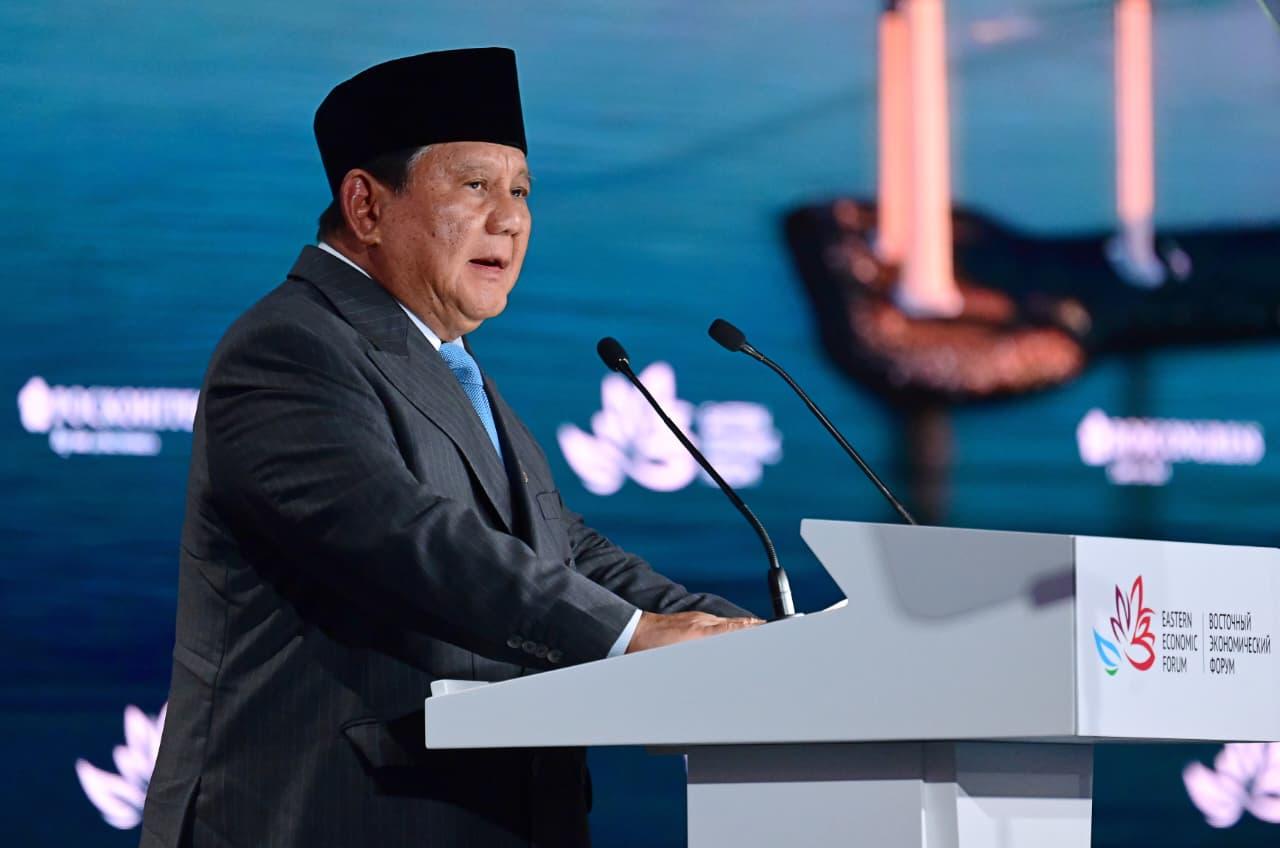
In his address at the 11th Eastern Economic Forum (EEF) at the Far Eastern Federal University (FEFU) in Vladivostok, Russia, President Prabowo Subianto emphasized that development must not benefit only a select few but must deliver tangible improvements to people’s lives.
Speaking at the forum, themed “The Far East: Development for the Benefit of People,” the President stated that people-centered development also reflects the mandate entrusted to him by the Indonesian people.
The President also reiterated that Indonesia’s economic philosophy is grounded in realism and pragmatism, and the pursuit of the greatest good for the greatest number of people.
“Development cannot benefit only a select few. Development must be measured at the dinner table of ordinary families: whether children receive nutritious food, whether farmers can obtain fertilizer and sell their produce at fair prices, whether families can live in decent homes, whether young people can find productive jobs, and whether electricity reaches every household in every village,” the President said.
The philosophy, he added, underpins the Government’s priority agenda, including the provision of Free Nutritious Meals for children and mothers, efforts to achieve food self-sufficiency and energy security, and the acceleration of industrial downstreaming.
The measures are intended to ensure that Indonesia’s natural resources support domestic industrial development, skills development, and job creation.
“This is why we pursue faster economic growth, not growth for growth’s sake, but growth that can lift millions of people out of poverty and lead them toward a dignified life,” the President emphasized.
The President also highlighted major opportunities for economic cooperation between Indonesia and Russia. According to him, the countries’ differing economic strengths complement each other. Russia is strong in wheat, fertilizer, energy, science, and advanced engineering, while Indonesia offers palm oil, fisheries, coffee, rubber, textiles, furniture, consumer goods, a young workforce, and access to the ASEAN market.
The results of stronger cooperation are reflected in bilateral trade, which reached nearly US$5 billion in 2025, up 21.7 percent from 2024 and 33.7 percent from 2023. The President emphasized that this achievement was only the beginning.
“This achievement is only the beginning, not the upper limit,” he said.
At the forum, the President also urged Indonesia and Russia to adopt a more ambitious goal: doubling bilateral trade during the first review period of the Indonesia–Eurasian Economic Union (EAEU) Free Trade Agreement (FTA). He said the growth should be supported by the two economies’ complementary strength, the FTA’s expected entry into force in early 2027, and deeper connections between Indonesian, Russian, and wider Eurasian business communities.
The Head of State also underscored ASEAN’s experience as evidence that peace can be built through consultation and cooperation rather than confrontation and division. According to him, that approach has produced a “peace dividend” for nearly six decades, thereby enabling economic, educational, and trade activities, as well as people’s lives, to thrive in a stable environment.
Indonesia, he added, invited Russia and all EAEU member states to maximize the agreement’s benefits by strengthening economic and logistical connectivity between Eurasia and Southeast Asia. The Indonesia–EAEU Free Trade Agreement, signed in St. Petersburg on 21 December 2025, provides for the elimination or reduction of tariffs on 11,882 tariff lines, covering more than 90 percent of goods traded between the parties.
The President also said that Indonesia had completed its parliamentary approval process and that he had signed the Presidential Regulation ratifying the agreement in July 2026. He also urged all EAEU member states to complete their respective internal procedures so that the agreement could soon be utilized.
“Indonesia hopes that this agreement can enter into force and be implemented as soon as possible following the exchange of notifications. I therefore urge each EAEU member state to complete its internal procedures so that we can soon begin reaping the benefits of this agreement,” he said.
President Prabowo Subianto also emphasized that the FTA must translate into concrete trade. Indonesia’s business delegation, also present in Vladivostok, has been preparing for the first shipment by identifying buyers, securing logistics routes, and putting payment mechanisms in place so that, once the tariff schedule takes effect, the goods, routes, and contracts are ready.
“This forum is a marketplace for the agreement,” the President concluded.
From Vladivostok, the President emphasized the direction of Indonesia’s economic diplomacy: agreements must translate into trade; trade must create jobs; and growth must ultimately benefit the people. (BPMI of Presidential Secretariat) (FI/EP)