
School Revitalization: Manifestation of State’s Presence in Education Quality Improvement


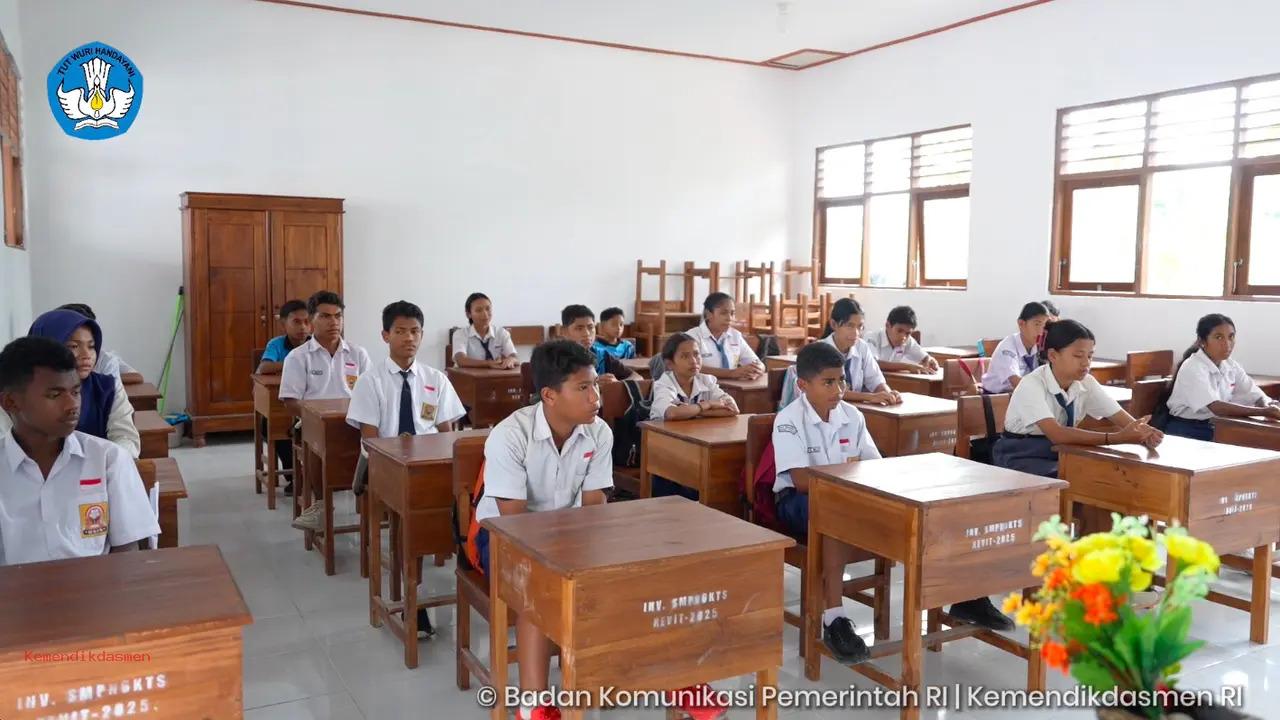
The Government continues to strengthen its commitment to improving national education quality by providing educational facilities and infrastructure that are decent, safe, and comfortable for students. The revitalization program for educational institutions serves as a concrete step taken by the Government to ensure that every Indonesian child has access to a learning environment that supports their growth, development, and learning process.
This commitment aligns with the directives from President Prabowo Subianto to accelerate the improvement of schools and educational facilities throughout Indonesia. The President has set a target to complete the renovation of all schools and educational facilities in need of repair by 2029 at the latest, ensuring that no students are left to study in classrooms with unsafe building conditions.
The school revitalization program also serves as a manifestation of the state’s presence in meeting the public’s basic needs within the education sector. Beyond focusing on physical infrastructure improvements, the program is intended to create a more conducive educational environment, allowing students to learn more comfortably and optimally.
Accelerating School Revitalization
In Bali province, the acceleration of the revitalization of educational institutions has shown a significant increase. In 2025, the revitalization program reached 188 schools, while in 2026, that number will rise to 401 educational institutions.
This improvement is part of the Government’s efforts to accelerate the equitable development of educational facilities, including for schools that have long faced infrastructure limitations and damage.
One of the benefits of the program was experienced by State Elementary School 15, Dangin Puri subdistrict, in Denpasar city. Prior to the revitalization, a classroom on the school’s third floor had sustained damage caused by rain and winds for years.
Following the revitalization, the school’s classrooms are now in better condition—tidy and clean. This transformation has created a more comfortable learning environment for students, encouraging them to be even more enthusiastic about their studies.
A similar situation was experienced by Indraprasta Kuta Kindergarten, in Badung regency. The school, which has been in existence since 1975, previously faced various infrastructure issues—ranging from leaking roofs and fragile walls to damage caused by flooding and termites.
Through the 2026 revitalization program, a number of the school’s facilities have undergone improvements, including six classrooms, an administrative office, a restroom, and the development of a playground. These upgrades provide a more suitable learning environment while also enhancing comfort for the students.
Creating a Broader Impact
The implementation of school revitalization also has a broader impact on the community. Beyond improving the quality of educational facilities, the development carried out through this program also creates employment opportunities for local residents.
Minister of Basic and Secondary Education Abdul Mu’ti stated that the revitalization program not only contributes to improving the quality of educational institutions but also generates an economic impact through the absorption of local labor.
This demonstrates that the development of educational infrastructure yields multifaceted benefits. Improving schools not only creates better learning spaces for students but also helps stimulate economic activity within the community surrounding the construction site.
Thus, educational development becomes a vital part of the national development agenda—one that is oriented not merely toward physical infrastructure, but also toward enhancing the quality of human resources and the well-being of society.
Ensuring the State’s Presence
The Ministry of State Secretariat continues to support the implementation of government policies, ensuring that the President’s priority programs are carried out in a coordinated manner and deliver tangible benefits to the public.
Education serves as one of the primary foundations for developing Indonesia’s human resources. Consequently, improving the quality of educational facilities and infrastructure must go hand in hand with enhancing the learning quality, teachers’ quality, and the expansion of access to education for the entire population.
Accelerating the revitalization of schools is also part of the Government’s vision to deliver development that yields direct, tangible benefits for the public. It is hoped that better-equipped schools will provide Indonesian children with a space to learn that is safe, comfortable, and inspiring.
Through the synergy of ministries, institutions, local governments, educational units, and all stakeholders, the Government will continue to ensure that educational development is carried out sustainably and reaches communities across various regions of Indonesia.
The state’s involvement through the construction and revitalization of schools is, in the end, not only about just improving buildings, but it is also about creating a better environment for the next generation to learn, grow, and realize the vision of an advanced, independent, and prosperous Indonesia. (Bureau of Press, Media, and Information of Presidential Secretariat) (AW/TM)