
Food Self-Sufficiency 2025: A Historic Milestone in Indonesia’s Food Independence


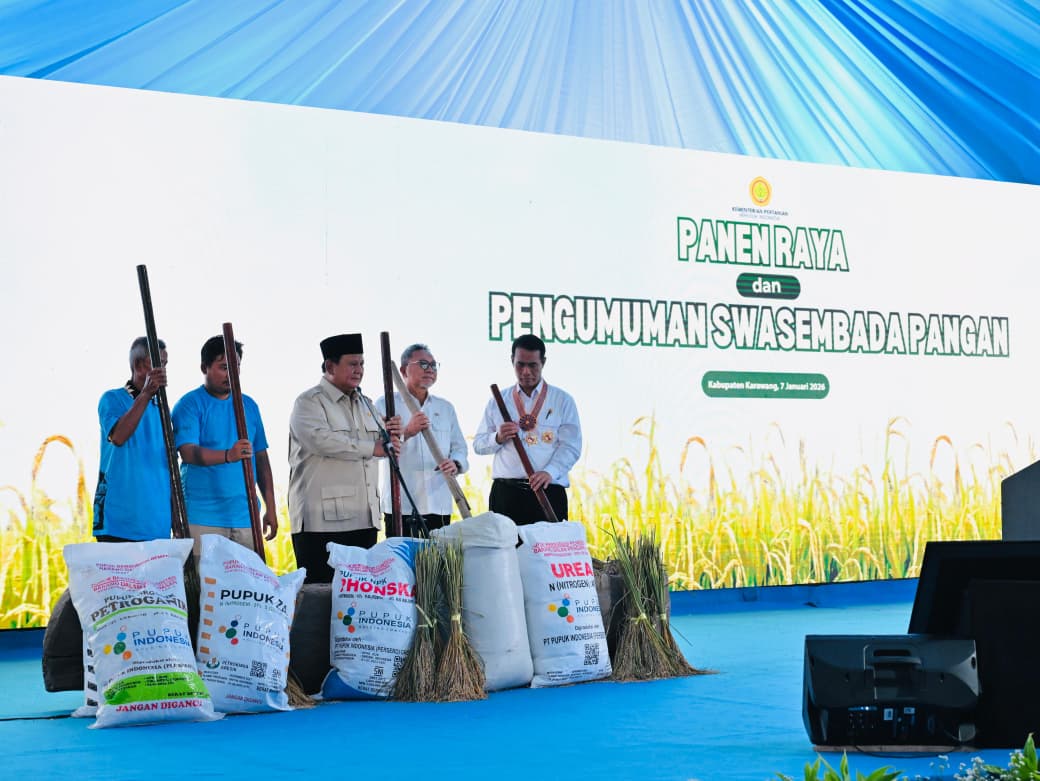
Indonesia achieves a new milestone in national development through food self-sufficiency in 2025.
Indonesia has recorded a new historic milestone in its national development with the achievement of food self-sufficiency in 2025. This accomplishment was realized faster than the national target, which is only in one year instead of four years as has been set by the Government.
The Great Harvest and Announcement of the 2025 National Food Self-Sufficiency, took place in Karawang regency, West Java province, on Wednesday (01/7), were held to commemorate the historic achievement. The event also served as a hallmark of Indonesia’s success in strengthening food security while significantly reducing its dependence on imports.
President Prabowo Subianto emphasized that food self-sufficiency is the fundamental pillar of a nation’s sovereignty and independence. According to the President, a country cannot be considered truly independent if its food needs still rely on other nations.
“No nation can be free if it cannot provide food for its people. A nation cannot be independent if its food supply depends on other countries,” emphasized the President.
The achievement of food self-sufficiency in 2025 is reflected in several key indicators demonstrating a substantial strengthening of the national agricultural sector. National rice production in 2025 reached 34.71 million tons, an increase of 4.09 million tons, or 13.36 percent, compared to 2024. This production growth resulted in a rice surplus of 3.52 million tons, enabling Indonesia to avoid importing consumption rice throughout 2025.
In addition, rice stocks managed by the State Logistics Agency (Bulog) reached 3.24 million tons by the end of 2025 and at one point peaked at 4.2 million tons, the highest level in the history of national food management. This condition strengthened the Government food reserves and provided greater policy flexibility in maintaining domestic price stability and supply.
The success of food self-sufficiency has also had a direct impact on farmers’ welfare. The Farmer’s Exchange Rate (Nilai Tukar Petani/NTP) in 2025 stood at 125.35, the highest level in the past 25 years, indicating a significant improvement in farmers’ purchasing power and income.
From trade perspective, the national agricultural sector demonstrated strong export performance. The value of agricultural exports from January to October 2025 reached Rp629.7 trillion, an increase of 33.6 percent compared to the same period of the previous year. This achievement confirms that Indonesian agriculture is not only capable of meeting domestic needs but is also becoming increasingly competitive in the global market.
The Government emphasized that food self-sufficiency in 2025 is not the final goal, but rather a foundation for strengthening sustainable national self-reliance. Going forward, the Government is committed to maintaining consistent production, expanding self-sufficiency to other strategic commodities, and ensuring that the benefits of agricultural development are felt equitably by farmers, fishers, and the community. (Bureau of Press, Media, and Information of the Presidential Secretariat) (TCUD/MMB)