
Gov’t Announces One-Day WFH Policy, Adapting to Global Dynamics


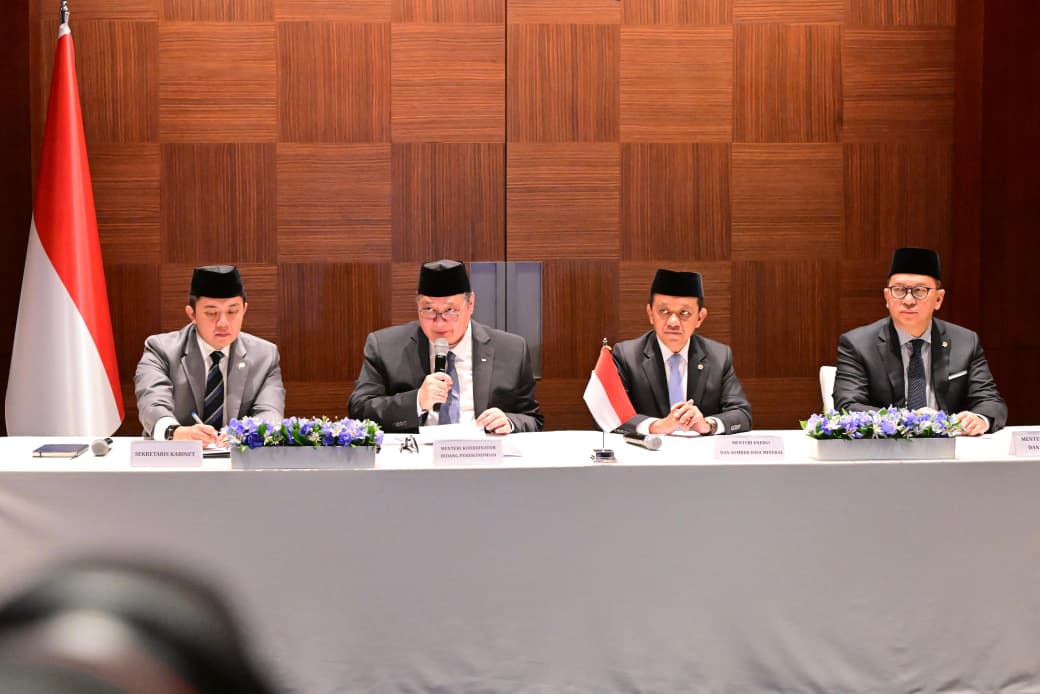
Coordinating Minister for Economic Affairs Airlangga Hartarto delivers press statement in Seoul, South Korea, Tuesday (03/31).
In a bid to adapt to the current global dynamics, the Government has decided to enforce a policy on national work culture transformation that aims at reducing fuel consumption and people’s mobility.
“As an adaptive and preventive measure to address global dynamics, the Government has announced a policy on work culture transformation that encourages changes in work behavior to be more efficient, productive, and digitally oriented,” Coordinating Minister for Economic Affairs Airlangga Hartarto said in his press statement in Seoul, South Korea, Tuesday (03/31).
He stated that one of the measures to be taken is to apply a work-from-home (WFH) scheme for civil servants at both central and regional governments. The WFH arrangement will be implemented once a week, every Friday. Regulated under Circulars of the Minister of State Apparatus Empowerment and Bureaucratic Reforms and Minister of Home Affairs, this scheme aims at promoting transformation towards digital-based governance.
In the effort to reduce people’s mobility, the Government promotes the use of public transportation and limits the use of official vehicles by 50 percent except electric vehicles, unless it is used for operational service. In addition, official trips are also being reduced by 50 percent for domestic trips and 70 percent for overseas trips. Local governments are also advised to expand the coverage areas for car free day, adjusting to conditions of respective regions.
A similar policy is also encouraged for the private sector through regulations outlined in Circular of the Minister of Manpower, while still taking into account the types of each business sector. Public service sectors such as healthcare, security, and sanitation, as well as strategic sectors such as industry or production, energy, water, essential goods, food and beverages, trade, transportation, logistics, and finance are exempted from WFH policy. The regulation also includes initiatives to promote energy efficiency at workplaces.
In the education sector, Airlangga explained that teaching and learning activities will continue to be conducted fully in person for primary to secondary education levels, five days a week, without restrictions on sports or extracurricular activities. Meanwhile, for higher education, particularly concerning [students at] semester four and above, the arrangement will adjust to policies set by the relevant ministry.
Furthermore, the Government also urged the public to support this policy by adopting energy-saving lifestyles, using public transportation, and maintaining economic productivity. This policy will take effect on April 1, 2026, and will be evaluated after two months of implementation.
According to Airlangga, this policy potentially generates significant savings to the state budget, amounting to Rp6.2 trillion, in the form of reduced fuel compensation. The policy will also save Rp59 trillion from total public fuel expenditure. (BPMI of Presidential Secretariat) (RAS/MMB)