
Gov’t Launches Strategic Policies for Economic Resilience amid Global Dynamics


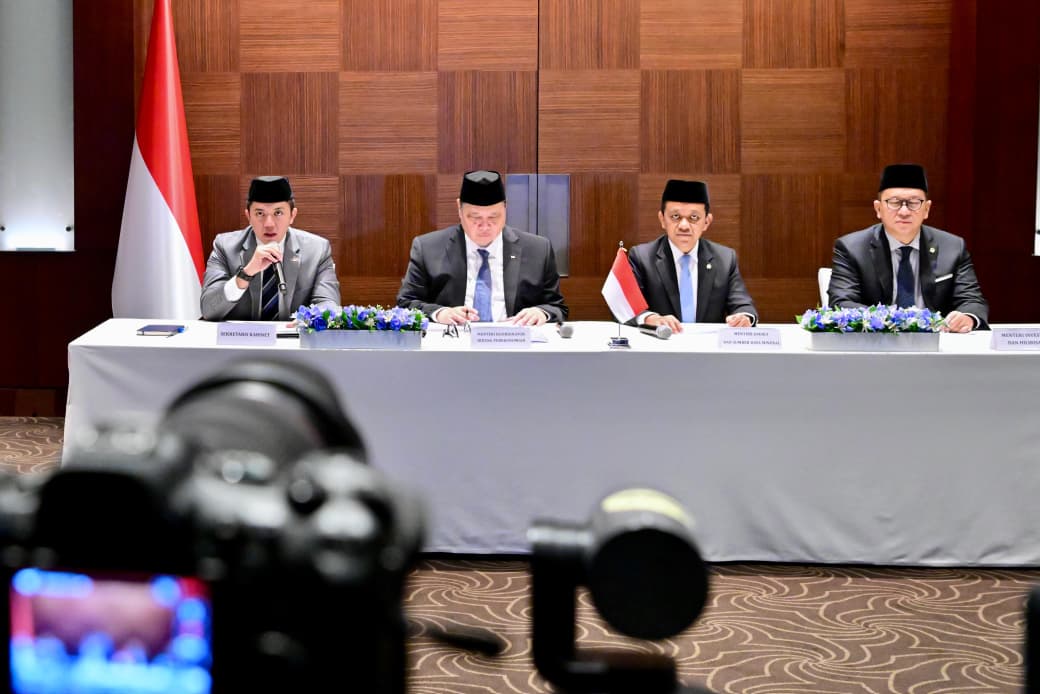
Indonesian Government launches a strategic policy package for risk mitigation and anticipation for global dynamics, via a hybrid press conference held from Seoul, Republic of Korea, Tuesday (03/31)
The Indonesian Government, Tuesday (03/31), launched a strategic policy package aimed at mitigating risks and anticipating global dynamics, via a hybrid press conference held from Seoul, Republic of Korea.
The policies focus on national work culture transformation, energy efficiency, and strengthening national economic resilience.
The press conference was attended by Coordinating Minister for Economic Affairs Airlangga Hartarto, Minister of Energy and Mineral Resources Bahlil Lahadalia, Minister of Investment and Downstreaming/Head of BPI Danantara (Indonesia’s Sovereign Wealth Fund) Rosan Roeslani, Minister of Marine Affairs and Fisheries Sakti Wahyu Trenggono, and Cabinet Secretary Teddy Indra Wijaya. Several other ministers joined the conference virtually from Jakarta, including Minister of State Secretary Prasetyo Hadi, Minister of Finance Purbaya Yudhi Sadewa, Minister of Manpower Yassierli, and Minister of State Apparatus Empowerment and Bureaucratic Reform Rini Widyantini.
In his opening remarks, Cabinet Secretary Teddy Indra Wijaya stated that the Government has established several key policies ready for immediate implementation in response to global dynamics. “Tonight, we will convey policies decided by the Government on March 31, 2026, regarding national work culture transformation and energy policies,” Teddy said.
Coordinating Minister for Economic Affairs Airlangga Hartarto added that these policies directly follow President Prabowo’s directives to bolster national economic resilience amid global uncertainties. He explained that the Government has launched the “Eight Pillars of National Work Culture Transformation” as adaptive and preventive measures.
“The policies are called ‘the Eight Pillars of National Work Culture Transformation’ and will be followed by other policies on energy as well,” Airlangga said.
One major policy is the national work culture transformation, including flexible work arrangement, such as work from home for state apparatus and similar encouragement for private sectors, tailored to each sector’s characteristics.
“This work culture transformation policies promote more efficient, productive, and digital-based work behavior changes,” he added.
The Government is also promoting mobility efficiency, public transportation use, and energy conservation in all levels of the government and across businesses and public sectors. In energy sector, the strategic policies aim to boost energy independence, including the application of B50 biodiesel to reduce reliance on fossil fuels. While in the fiscal sector, the Government is tightening state spending by refocusing the state budget on more productive sectors producing direct positive impacts on the public.
“The value of potential prioritization and refocusing of ministerial and agency budgets ranges from Rp121.2 trillion to Rp130.2 trillion,” Airlangga stated.
He also highlighted that these policies are part of a structural transformation toward a more resilient national economy. The Government calls on all elements of society and businesses to remain productive and actively support the implementation of those policies which are set to be effective from April 1, 2026 and will be evaluated in the next two months.
“All these policies are part of structural transformation toward a more efficient, productive, and resilient economy,” he remarked.
These steps not only address global challenges but also build a new stronger, more efficient, and sustainable economy for Indonesia in the future. (BPMI of Presidential Secretariat) (EST/TM)