
President Prabowo Pushes Acceleration of AI-Based GovTech to Strengthen State Governance and Budget


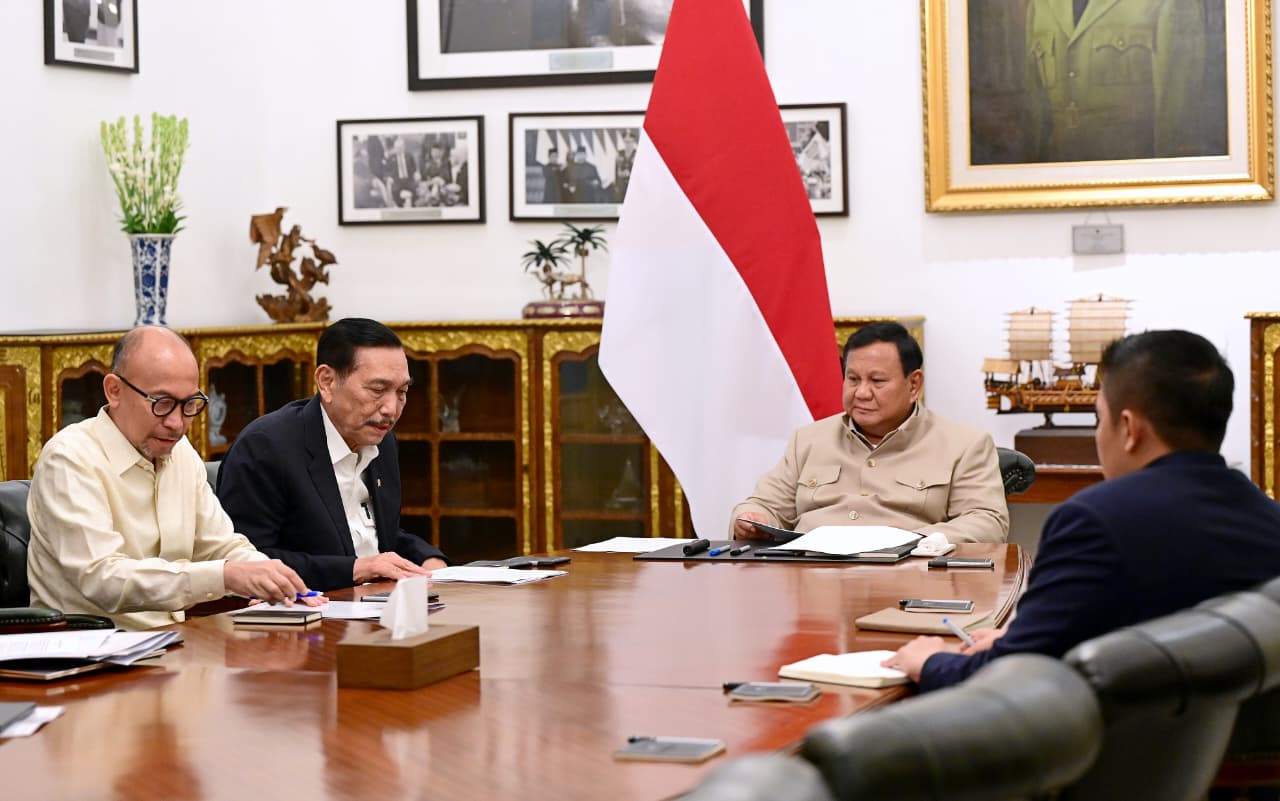
President Prabowo receives Chairperson of the National Economic Council (DEN) Luhut Binsar Pandjaitan and DEN delegates, at the Merdeka Palace, Jakarta, Tuesday (06/09) (Photo by: BPMI of Presidential Secretariat)
The Government continues to boost national digital transformation as a foundation to strengthen governance, increase budget, and improve public service quality. Chairperson of the National Economic Council (DEN) Luhut Binsar Pandjaitan gave the statement after a meeting with President Prabowo and DEN delegates, at Merdeka Palace, Jakarta, on Tuesday (06/09).
During the meeting, Luhut mentioned that DEN reported to President Prabowo that 80 percent of GovTech (Government Technology) system applied to digitalize the management of social assistance has been connected. He added that since June 1, 2026, for the first time, data collected from eight ministries and government major institutions have been successfully integrated in a system supported by AI (artificial intelligence) technology.
“So, all those data have been connected and cleared by AI. Yesterday, for example, during the meeting in the House of Representatives, we were questioned about how face recognition can resolve the issue on court appeal in just one minute. So, GovTech will be a crucial part in President Prabowo’s government. Why? Because all data will be well-compiled, and nothing can escape from the data compilation,” Luhut explained.
According to Luhut, through the system, the Government will also expand the scope of the development of micro, small, and medium enterprises (MSMEs). He added that with more complete and integrated data base, the Government can broaden the tax base gradually and generate new MSMEs, as well as create job opportunities.
“All of those [parts of the system] will be connected to the national single window at the Ministry of Finance. I think this is important, because with GovTech, we will reach out to the 64 million MSMEs so they can also take part in the 0.5 percent tax payment. If that happens, our tax ratio will increase from the current 9 percent to perhaps 12-13 percent over time, and from that point, state revenue will also increase significantly,” Luhut added.
Luhut further explained that GovTech development is being carried out efficiently by leveraging the already existing digital ecosystems, such as PeduliLindungi, e-Katalog, and Simbara, and is being developed by young Indonesian talents. As part of the national implementation, the Government is currently running pilot projects in 42 provinces, regencies, and cities.
“It has been implemented in Banyuwangi and it has been very successful. We’ve learned from this model. If this is successful in the 42 regions, we’ll roll it out nationally this October, connecting all 514 regions,” Luhut said.
On the occasion, Luhut also conveyed President Prabowo’s directives regarding the development of the International Financial Center and the family office scheme. According to Luhut, the Government expects these initiatives will increase Indonesia’s attractiveness as a global investment destination.
In the area of public services, Luhut explained that the Government is also preparing a digital single ID, which is targeted to be launched by the end of this year. Through this integrated, AI-powered digital identity system, the distribution of social assistance and various forms of direct government transfers will be more properly targeted.
“Perhaps by the end of this year, there will be a digital single ID, which will result in well-targeted social assistance or direct cash transfers, and that will save a significant amount [of fund]. Some of the savings could be quite substantial, and I think subsidies will not be allocated for goods. Subsidies will go directly to recipients because, on average, we collect all social assistance through cash transfers, and so on. The social assistance amounts 5.4 million rupiah per person, and those entitled to the social assistance will later be grouped with the assistance of AI,” Luhut said.
Luhut emphasized that the ongoing digital transformation represents a major step toward a modern, data-driven Government. He believes Indonesia has the potential to become one of the first countries with a large population to implement a comprehensive digital and AI-based government system.
“So, this is a government with a population of nearly 300 million people, and early next year, it will be the first to use AI-based digitalization. I think this is a bold move, because I mentioned earlier that everything can be monitored with this system, and once again, this system was built by Indonesians,” Luhut concluded. (Bureau of Press, Media, and Information of Presidential Secretariat) (AW/TM)