
President Prabowo Reviews BRIN Innovations


President Prabowo Subianto reviewed a number of research outcomes and innovations developed by the National Research and Innovation Agency (BRIN) before meeting with around 150 BRIN researchers at the Presidential Palace Compound in Jakarta on Thursday (08/06). The review was part of the Government’s efforts to directly observe the development of various strategic innovations projected to support the accelerated implementation of the national development agenda.
During the review, President Prabowo was accompanied by Head of BRIN Arif Satria, who guided the President through various innovation booths covering a range of fields, including energy, defense, aerospace, health, food, and water treatment technology.
Throughout the activity, President Prabowo appeared enthusiastic as he observed the various research outcomes, asked the researchers a number of questions, and listened carefully to explanations about the potential applications of the technologies being developed.
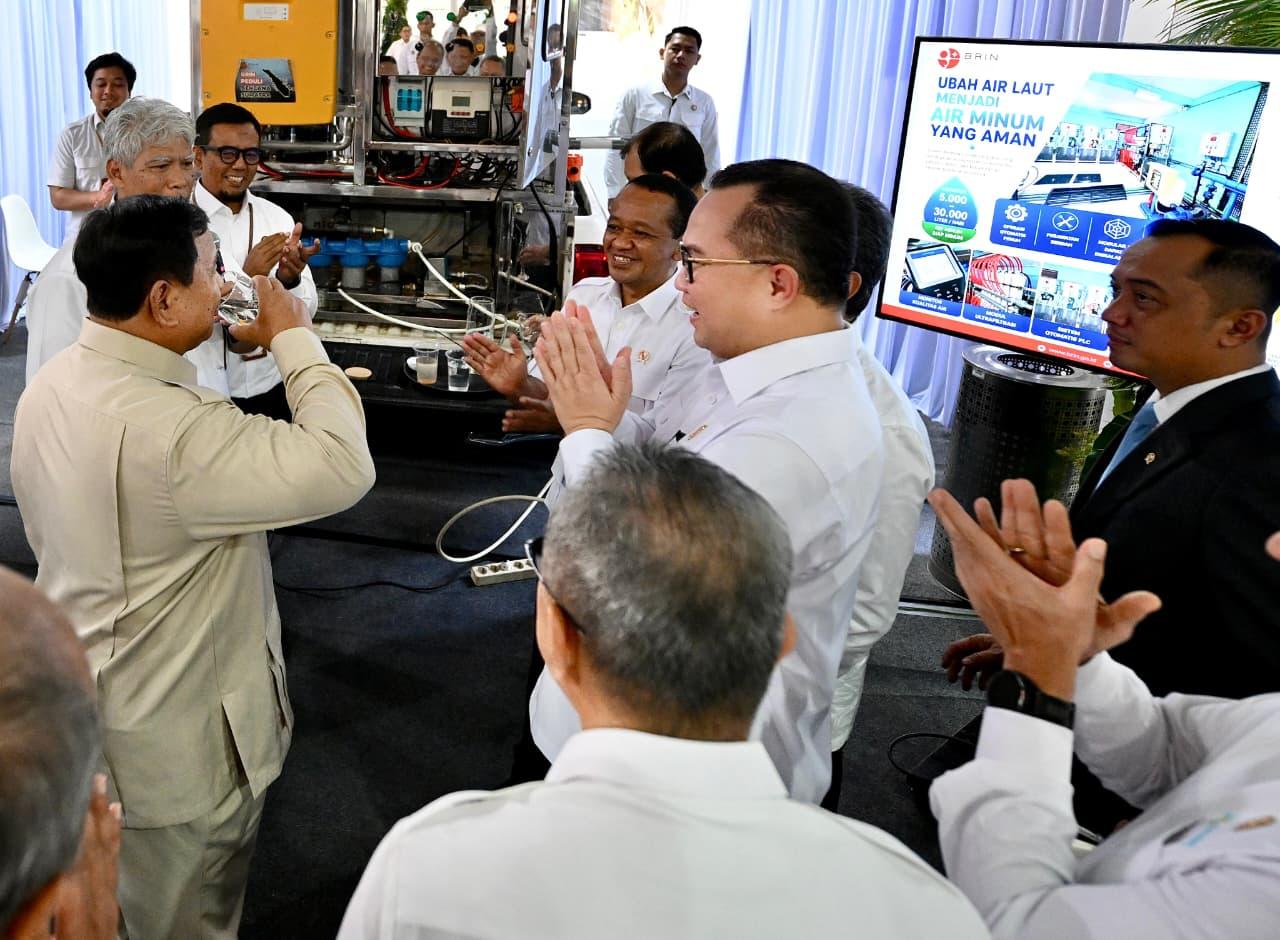
One of the innovations that attracted the President’s attention was an emergency water treatment unit capable of processing floodwater, brackish water, groundwater, and river water into drinking water. The President also had the opportunity to try the water produced by the technology, which has been used in various disaster response operations and to meet clean water needs.
In his report to the President, Arif Satria explained that the various innovations on display were part of the development of national technological capabilities in strategic sectors. In the energy sector, for example, BRIN is developing low-pressure natural gas storage technology based on Metal Organic Framework (MOF) through a Sister Lab collaboration with 2025 Nobel Prize winner in Chemistry Susumu Kitagawa.
“Based on our preliminary calculations, this technology has the potential to reduce the LPG subsidy burden by up to around Rp26 trillion per year,” Arif said.
In the aerospace sector, BRIN is developing several capabilities ranging from aircraft design and unmanned aerial vehicles to Earth-observation satellites. He said that the N219 aircraft has now been licensed to PT Dirgantara Indonesia for production, while the NEO-1 satellite is scheduled for launch in early 2027 to support national data needs in agriculture, forestry, maritime affairs, disaster mitigation, and maritime surveillance. The satellite is expected to achieve mission cost efficiency of around 71.9 percent compared with similar missions.
In the defense and security sector, BRIN is also developing various strategic technologies, including the Alap-Alap Unmanned Aircraft, which can fly for up to six hours with a range of approximately 100 kilometers. According to Arif, the technology can support monitoring, surveying, mapping, and area surveillance missions more efficiently.
Meanwhile, in the transportation and food security sectors, BRIN continues to develop electric vehicles, maritime technology, flexible-fuel engines, and innovations supporting the Free Nutritious Meals (MBG) Program. In addition, BRIN is developing electric-powered fishing vessels that have the potential to reduce energy operating costs by up to 70 percent compared with the use of fuel oil.
In the health sector, BRIN is developing various innovations, including vaccines, diagnostic technologies, radiopharmaceuticals, and medical devices. In the industrial sector, BRIN has successfully developed school shoes made from locally sourced rubber using One Piece Injection Molding technology, with production costs below Rp70,000. BRIN is also developing smart insoles for medical rehabilitation, sports, and occupational safety.
Arif also presented various other strategic technology developments, ranging from critical mineral processing and nuclear technology to modular housing systems, coastal protection technology for the Giant Sea Wall, waste management technology, and water desalination. According to him, mastery of these technologies is an important foundation to ensure that Indonesia is not merely a technology user, but also a national technology developer.
“BRIN must prepare Indonesia’s nuclear technology capabilities from now on, so that when Indonesia decides to enter the nuclear power plant era, we will not be starting entirely from scratch and will not merely become technology buyers,” Arif said.
Concluding his report, the Head of BRIN stressed that the products on display were not merely research outcomes, but also reflected Indonesia’s capacity to build national technological self-reliance. Arif emphasized that the next challenge is to connect research outcomes with the needs of the Government, industry, and society so that the innovations can be widely utilized.
He also expressed optimism that the President’s support will further strengthen the role of research and innovation in supporting the national development agenda. “With the President’s direction and support, Indonesian research and innovation will be increasingly capable of supporting the implementation of the Asta Cita and accelerating the achievement of national priorities as the foundation for Golden Indonesia 2045,” he said. (BPMI of Presidential Secretariat) (EST/AW)