
Two Years of Concrete Action: Red-and-White Fishing Villages Boost Fishers’ Productivity and Income


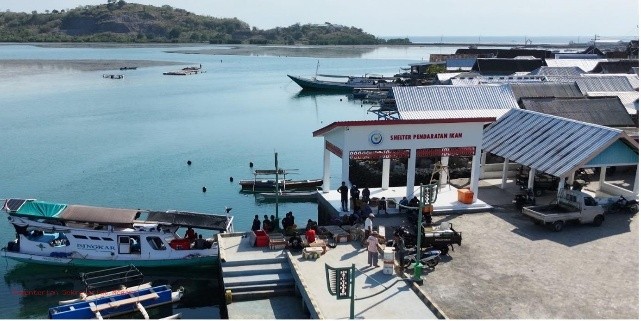
Improving fishers’ welfare has remained a priority for President Prabowo Subianto and Vice President Gibran Rakabuming Raka throughout their two years in office.
This commitment is reflected in the Red-and-White Fishing Villages (Kampung Nelayan Merah Putih/KNMP) program, which is integrated with the Red and White Village/Subdistrict Cooperatives (Koperasi Desa/Kelurahan Merah Putih/KDKMP). Under the theme “Two Years of Concrete Action”, the KNMP program highlights the Government’s efforts to strengthen the national food sector.
Launched in 2025, the program is a priority initiative of Ministry of Marine Affairs and Fisheries (KKP). It was conceived as one of the National Strategic Programs aligned with the President’s national priorities of Asta Cita. The program is also designated as a priority under Presidential Instruction No. 14 of 2025 on Accelerating the Development of National Food, Energy, and Water Self-Sufficiency Areas.
The program aims to transform coastal areas and aquaculture villages into competitive, sustainable, and productive centers of the maritime economy. KNMP adopts a community-based approach, integrating the entire value chain, from production and processing to distribution and marketing, within a single area.
In his State of the Nation Address at the Annual Session of the People’s Consultative Assembly (MPR RI) (08/14), President Prabowo Subianto stated that KNMP would be equipped with a range of facilities to support fisheries activities. These would include ports, docks, fish auction facilities, cold storage facilities, workshops, seafood processing facilities, housing, and social amenities.
“Our fisheries are worth around US$34 billion annually, yet we may only capture about 5 percent of that value. The rest is taken by foreign vessels operating in our waters without our permission,” the President said in his State of the Nation Address at the Joint Session of the MPR, the House of Representatives (DPR), and the Regional Representatives Council (DPD) at the Nusantara Building on Friday (08/14).
Since 2025, the Government has undertaken the development of 100 fishing villages across Indonesia. Of these, 65 KNMP sites developed in the first phase are already operational, while the remaining 35 are under development in the second phase.
The Government aims to establish 5,000 KNMP sites nationwide by 202, with development tailored to the geographical conditions, community needs, and the economic potential of each coastal area.
According to Ministry of Finance’s Directorate General of Budget, the 2025 State Budget (APBN) allocated up to Rp1.1 trillion to support KNMP development. The funds were used to develop the sites and provide facilities supporting fishers’ activities.
Increased Fishers’ Productivity, Higher Incomes
Ministry of Marine Affairs and Fisheries has designated KNMP Samber-Binyeri in Biak Numfor Regency, Papua, as a pilot project. Its establishment has helped improve local fishers’ productivity and livelihoods.
According to the Ministry’s data, fish production increased by 121 percent, from 552 kilograms per month to 1,221 kilograms per month. This growth was accompanied by higher fish sales and fishers’ incomes. Monthly fish sales rose by 90 percent, from Rp10.8 million per month to Rp20.5 million per month, while fishers’ monthly incomes increased by 89 percent, from Rp6.06 million per month to Rp11.43 million per month. Facilities provided through KNMP also enabled fishers to spend more time at sea, increasing their fishing days from nine to 13 days.
This strong performance has enabled the village to meet local consumption needs while also supplying fish to other parts of Indonesia. A total of 15 shipments, carrying 231 tons of fish worth Rp4.36 billion, have been sent to Jakarta, Semarang, Bitung, and Surabaya.
Fishers in Tongke-Tongke Village, Sinjai Regency, South Sulawesi, have experienced similar benefits since KNMP began operating there in May 2026. Within four months, their average monthly rose from Rp4 million to Rp7 million. KNMP operations in the village have also created jobs for 39 local workers and attracted 80 cooperative members.
In addition to supplying fresh fish, KNMP Tongke-Tongke processes fresh tuna into tuna loins. Through its cooperative partners, the village has shipped 65 tons of tuna loins worth Rp2.54 billion. Most recently, on September 27, 2026, it shipped another 12 tons to Jakarta to meet a fish processing facility’s demands for raw materials.
KNMP Operational Task Force Head Inspector General (Pol) Victor Gustaaf Manoppo explained that regular shipments of fisheries products from the area demonstrated the growth of a regional fisheries business ecosystem.
“This will certainly have a positive economic impact on fishers in the surrounding areas,” Victor said.
Sinjai Regent Ratnawati Arif said that KNMP offered opportunities to strengthen the economy of coastal communities. Cold storage and processing facilities, along with marketing networks, helped improve product quality and expand business opportunities for local communities. She added that the program could increase fisheries production and fishers’ incomes if the facilities were managed effectively.
“The program (KNMP) is projected to increase fisheries production by an average of approximately 800 tons per year at each site and raise fishers’ incomes by up to 75 percent,” she said.
Going forward, the Government will continue to expand KNMP in phases, working toward its target of establishing 5,000 fishing villages by 2029. The initiative is expected to strengthen national food self-sufficiency, create more jobs, and transform coastal areas into new centers of economic growth. Through these efforts, the transformation of the marine affairs and fisheries sector will be reflected not only in increased production but also in improved fishers’ welfare. (AMY- Public Relations Bureau of Ministry of State Secretariat) (AY/MEP)