
Education Ministry Makes Disaster Relief Efforts to Education Institutions in Flood-Affected Provinces


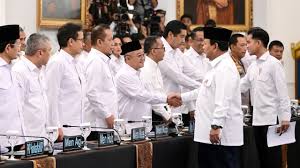
President Prabowo Subianto receives report from Minister of Primary and Secondary Education Abdul Mu’ti regarding the progress of disaster relief effort in education sector, at the Plenary Cabinet Meeting Monday (12/15). (Photo by: BPMI of Presidential Secretariat/Muchlis Jr)
President Prabowo Subianto receives report from Minister of Primary and Secondary Education Abdul Mu’ti regarding the progress of disaster relief effort in education sector, schools affected by flood in North Sumatra, West Sumatra, and Aceh, and the Government efforts to handle it.
“There are 767 early childhood education centers (PAUD), 1,343 elementary schools, 621 junior high schools, 268 high schools, 136 vocational high schools, 23 learning and teaching centers (PKBM), 30 special-needs schools, 86 course and training institutions affected by the disaster, bringing the total number to 3,274 affected (educational institutions). We have yet to map the level of damage because the process and data collection are still underway,” Abdul Mu’ti said.
In addition, 6,431 classrooms were damaged, along with 3,420 units of toilets, 3,489 other infrastructure facilities such as laboratories, libraries, school health units (UKS), places of worship, and IFP (Interactive Flat Panel) devices.
In the initial disaster response effort, the Government had distributed 148 units of emergency classroom tents, 15,000 school kits, 7,500 children’s gift packages, 2,000 pairs of shoes, 700 family kits, and 65,000 copies of books, both textbooks and non-textbooks.
“For assistance in the form of cash, Rp21.1 billion from our current existing budget, and Rp18.53 billion from the revised budget are allocated. In addition, special allowances for teachers in disaster-affected areas amounting Rp35 billion from the revised budget are also allocated. We can informed that 16,500 teachers are receiving assistance, with each teacher receiving Rp2,000,000, and the budget is still in the process of revision for the year 2025,” he explained.
The Minister also outlined a curriculum adjustment scenario to address the impacts of disasters. He explained that during the emergency response phase of 0 to 3 months, the curriculum is simplified to essential competencies covering basic literacy and numeracy, personal health and safety, psycho-social support, and disaster mitigation education.
For the early recovery phase of 3–12 months, an adaptive, crisis-based curriculum is implemented. Next are learning recovery programs, flexible and differentiated learning, a transitional assessment system, portfolio-based assessments, or assessments for simple work. For the extended recovery phase of 1–3 years, there will be permanent integration of disaster education, strengthening the quality of learning, and resilience-based inclusive learning, and an emergency education monitoring and evaluation system,” Abdul Mu’ti. said.
(BPMI of Presidential Secretariat) (RAS/LW)