
President Prabowo Subianto: Nation-Building Is a Shared Responsibility of All Elements of Society


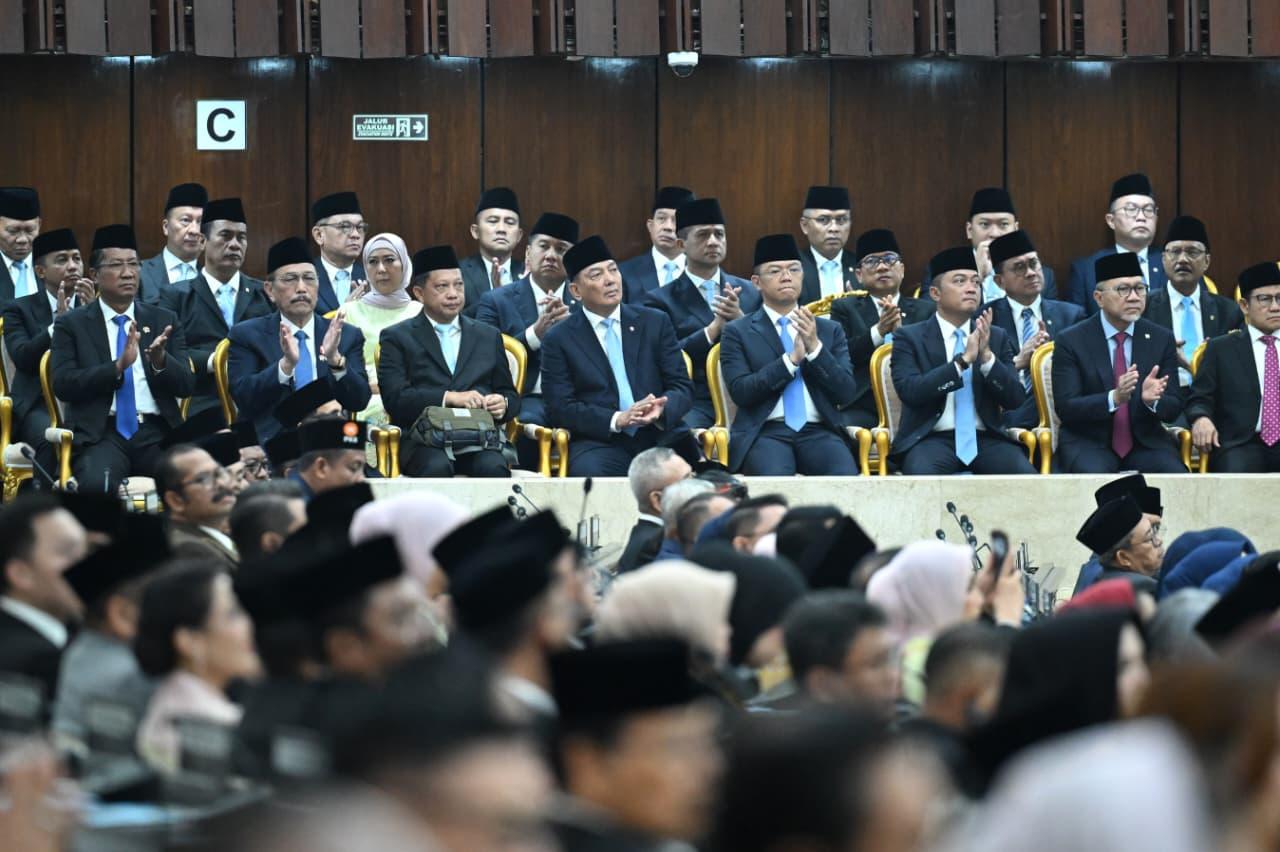
President Prabowo Subianto has underscored that nation-building is a shared responsibility of all elements of government and society, including state institutions.
“Nation-building is not the responsibility of the President alone, nor is it solely the responsibility of the Government. This Republic is built through the collective efforts of all state institutions, central and regional governments, and all elements of society, including the Indonesian people,” the President said during the Annual Session of the People’s Consultative Assembly of the Republic of Indonesia (MPR RI) and the Joint Session of the House of Representatives of the Republic of Indonesia (DPR RI) and the House of Regional Representatives of the Republic of Indonesia (DPD RI), at the Nusantara Building, Parliamentary Complex, on Friday (08/14).
The President also outlined the contributions of several state institutions in carrying out their constitutional duties. The MPR RI, he said, has continued to fulfill its role as the Rumah Kebangsaan (National House), by strengthening constitutional literacy and upholding Pancasila, the 1945 Constitution, the Unitary State of the Republic of Indonesia, and Bhinneka Tunggal Ika (Unity in Diversity).
“The DPR RI, together with the Government, finalized and passed 13 bills as of July 2026. One of them is Law Number 2 of 2026 on the Protection of Domestic Workers, which recognizes that every job has dignity and that every worker has the right to protection,” he said.
Meanwhile, according to the President, the DPD RI has received 10,883 aspirations from 38 provinces, as inputs for the 2027 Government’s Working Plan.
“The DPD also continues to advocate for the Bill on Archipelagic Regions, which has now entered tripartite deliberations involving the DPR and the Government,” he added.
In the judiciary, the Head of State also highlighted the Supreme Court’s performance in 2025, when it handled 38,148 cases and decided 37,973, achieving a productivity rate of 99.54 percent. A total of 96.74 percent of the cases were resolved within three months, marking the highest level of timeliness in case finalization in the history of the Supreme Court.
“In 2025, the Constitutional Court handled 701 cases and requests, including 334 disputes over the results of regional head elections. As many as 598 cases and requests had been adjudicated. As of July 23, 2026, 84.51 percent of requests to the Constitutional Court were filed online, sparing people from Aceh to Papua the need to travel to Jakarta,” the President said.
From January to June 2026, the Judicial Commission, he said, received 1,402 reports from the public and also proposed sanctions for 121 judges found to have violated the Code of Ethics.
Furthermore, the Audit Board of Indonesia (BPK), the President said, had helped recover Rp112 trillion in state finances through audit recommendations issued throughout 2025.
“Global trust in Indonesia’s auditors has also improved. The BPK has been appointed as Chair of the International Organization of Supreme Audit Institutions (INTOSAI) for the period of 2028-2031 and becomes a member of the United Nations Board of Auditors for the period of 2026-2032,” he added.
The President also emphasized the importance of strengthening judicial institutions while maintaining a balance between judicial independence and accountability. He said that judges are the last line of defense for the people in seeking and obtaining justice.
“The supremacy of law and justice must extend not only to the powerful but also to our most vulnerable citizens. They must also be able to obtain justice in our courts and judicial institutions,” he said. (BPMI of Presidential Secretariat) (FI/EP)