
Gov’t to Establish New Fuel Storage Facilities


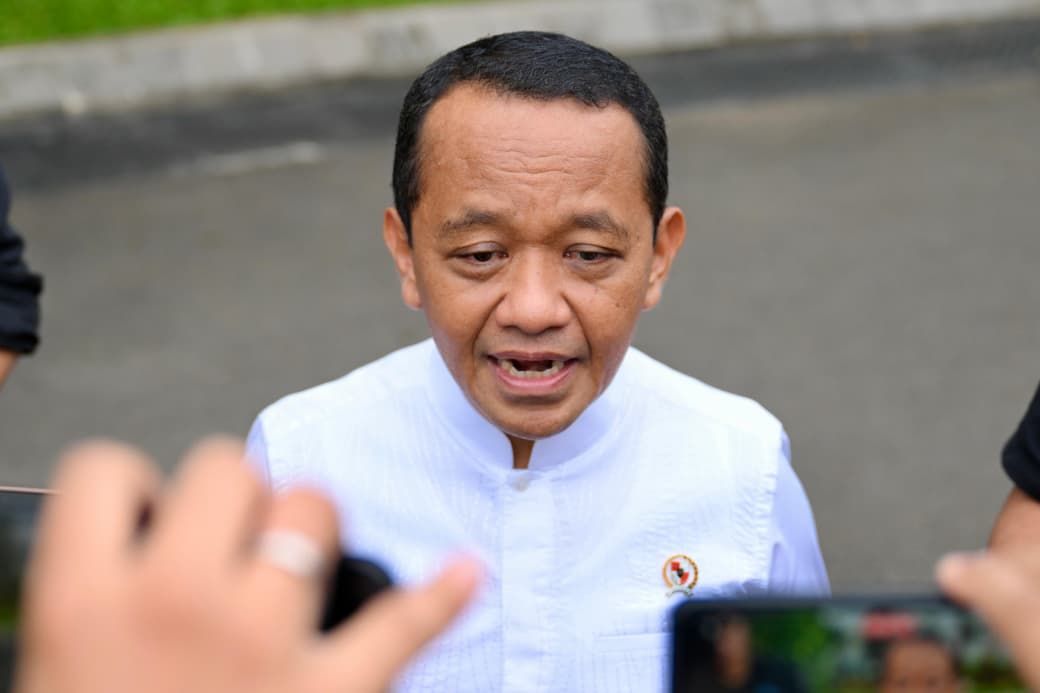
Minister of Energy and Mineral Resources Bahlil Lahadalia at the press conference, the Presidential Palace complex in Central Jakarta, Wednesday (03/04).
Minister of Energy and Mineral Resources Bahlil Lahadalia Wednesday (03/04) stated that Indonesia’s national fuel reserves are currently in a safe condition and have even exceeded the country’s minimum reserve standard.
“Our fuel storage capacity has long been limited to a maximum of 25 days. Therefore, our national reserve standard is at least 20 to 23 days. Currently, our fuel reserves stand at 23 days, which is already above the minimum national reserve standard,” Bahlil said at the Presidential Palace complex in Central Jakarta.
The Minister said that limited storage capacity remains one of the key challenges that must be addressed. As a result, President Prabowo Subianto instructed the Government to immediately build new fuel storage facilities to strengthen the country’s national energy reserves.
“We cannot simply say that we should have stock for 60 days. Where would we store it? We do not have the storage capacity. That is why the President instructed us to immediately build storage facilities,” he said.
The development of new storage facilities, Bahlil continued, is a crucial step to increase national energy reserves to up to three months and the Government is currently preparing several alternative locations. “One of the best alternatives is in the Sumatra region,” he added.
The Minister also highlighted the potential impact of global conflicts on energy supplies, while assuring that Indonesia’s energy supply remains secure for now.
“As of now, it has not been disrupted. But in the future, if the war continues for a long time, it will certainly have an impact. That is inevitable. For the next one to two months, inshallah, we are still in the clear. There should be no problem,” he said.
The Government, he added, also prepared several mitigation measures to anticipate potential disruptions to global energy supply routes, including diversifying sources of crude oil imports.
“As for LPG, there is no issue. For fuel imports, we only import gasoline, and we purchase it in Southeast Asia, not from the Middle East,” the Minister remarked. (BPMI of Presidential Secretariat) (GWH/LW)