
President Prabowo Issues Government Regulation on Natural Resource Export Governance, Emphasizes Utilization of Natural Resources for People’s Welfare


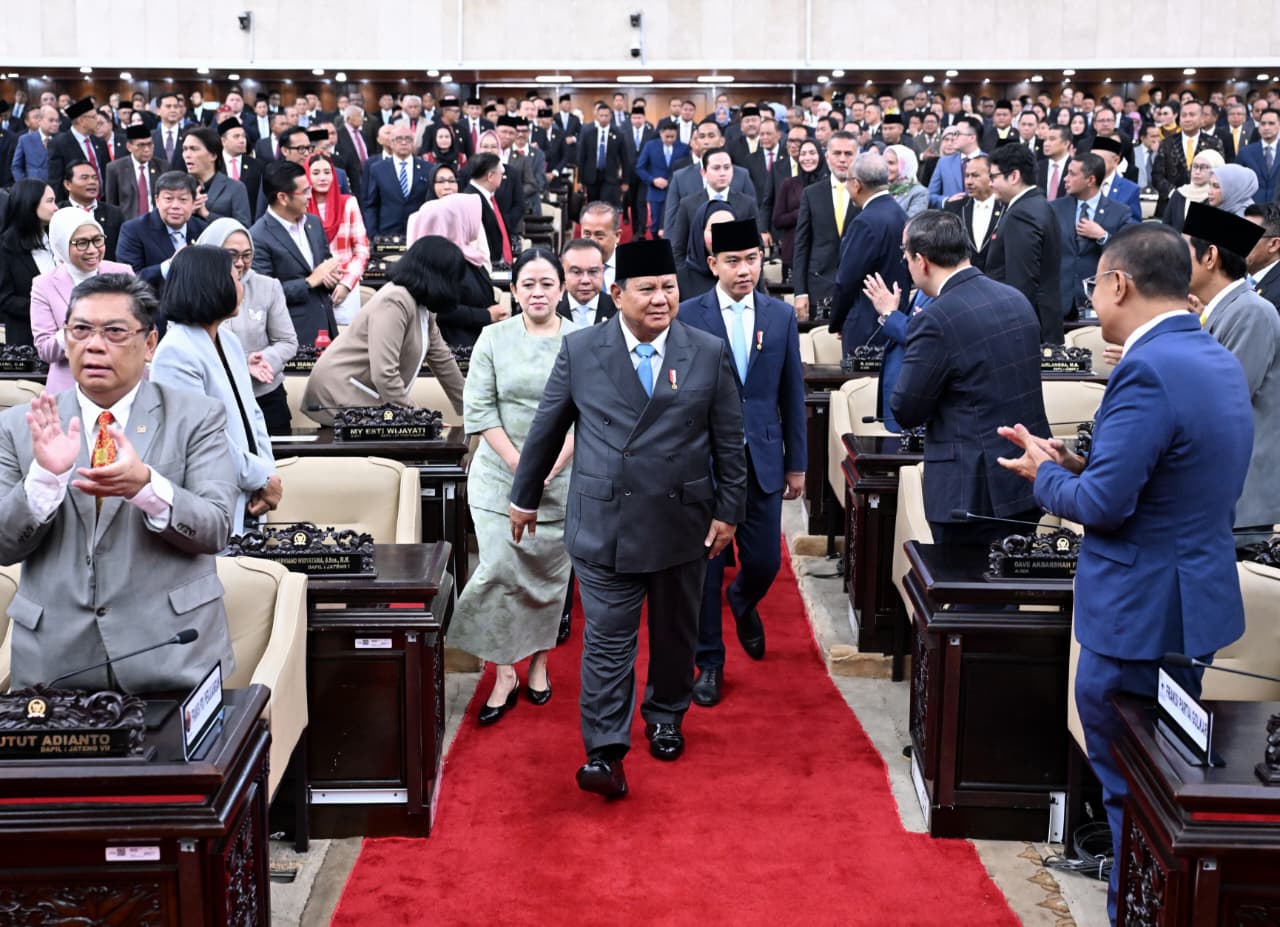
President Prabowo Subianto is welcomed by the parliament before delivering his remarks on Macro Economic Framework of Fiscal Policy Principles of 2027 Draft State Budget at the Plenary Meeting Room of Nusantara Building of MPR/DPR/DPD RI, in Jakarta, on Tuesday (5/20). (Photo by: BPMI of Presidential Secretariat)
President Prabowo Subianto announced the issuance of the Government Regulation on Natural Resource Commodity Export Governance as a strategic measure to strengthen supervision and governance of national commodity exports. The President delivered the statement in the plenary session of the House of Representatives (DPR) in Nusantara Building of MPR/DPR/DPD RI, in Jakarta, on Wednesday (5/20).
Through this policy, the President said, commodity exports must be carried out through State-Owned Enterprises (SOEs) appointed by the Government as the sole exporter. At its initial phase, the policy applies to three strategic commodities, namely palm oil, coal, and ferro alloys.
“The sale of our natural resource products, starting with palm oil, coal, and ferro alloys, must be conducted through SOEs appointed by the Indonesian Government as the sole exporter. It means that the proceeds of export sales will be passed on by the appointed SOEs to business actors managing the sales. This is what we call marketing facility,” said the President.
He said that the main purpose of this policy is to strengthen supervision and monitoring of natural resource commodity exports. In addition, this policy also aims to eradicate under-invoicing, transfer pricing, and capital flight on export proceeds to optimize state revenue.
“This policy will optimize tax revenue and state revenue over the management and sale of our natural resources,” he said.
The President also emphasized that all Indonesia’s natural resources belong to the Indonesian people. Therefore, the state has the authority to know in detail about the values, volumes, and destinations of Indonesia’s natural resource sales abroad.
He said further that the similar policy has been implemented by many countries succeeding in managing their natural resources for the interests of their peoples. He mentioned several countries, such as Saudi Arabia, Qatar, Russia, Algeria, Kuwait, Morocco, Ghana, Malaysia, and Vietnam as examples of countries succeeding in utilizing their natural resources as foundation for education, health, modern infrastructure, and world-class sovereignty fund.
“What Indonesia is doing today is not an odd policy, not a remarkable policy. Many countries have implemented such practices. This is a common sense policy. We have to determine where to sell our own natural resources. We determine the proper prices. We no longer want to be a victim and endure unfair treatment of other countries to our nation. I am here to say, it has to come to an end. Now, Indonesia stands on its own feet,” he stated.
In line with the export governance policy, the President also announced the efforts to strengthen foreign exchange policies for export proceeds derived from natural resource business, management, and processing. This policy aims to ensure that the contributions of natural resource business actors are optimized for the greatest prosperity of the people.
Through the issuance of the Government Regulation on Natural Resource Commodity Export Governance and the optimization of foreign-exchange export proceeds, the Government reaffirmed its commitment to ensuring that Indonesia’s natural resources are no longer leaking abroad and instead managed transparently and sovereignly, for the greatest prosperity of the people. (Bureau of Press, Media, and Information (BPMI) of Presidential Secretariat) (JAS/TM)