
President Prabowo, Police Reform Commission Discuss Comprehensive Reports on Police Reform Agenda


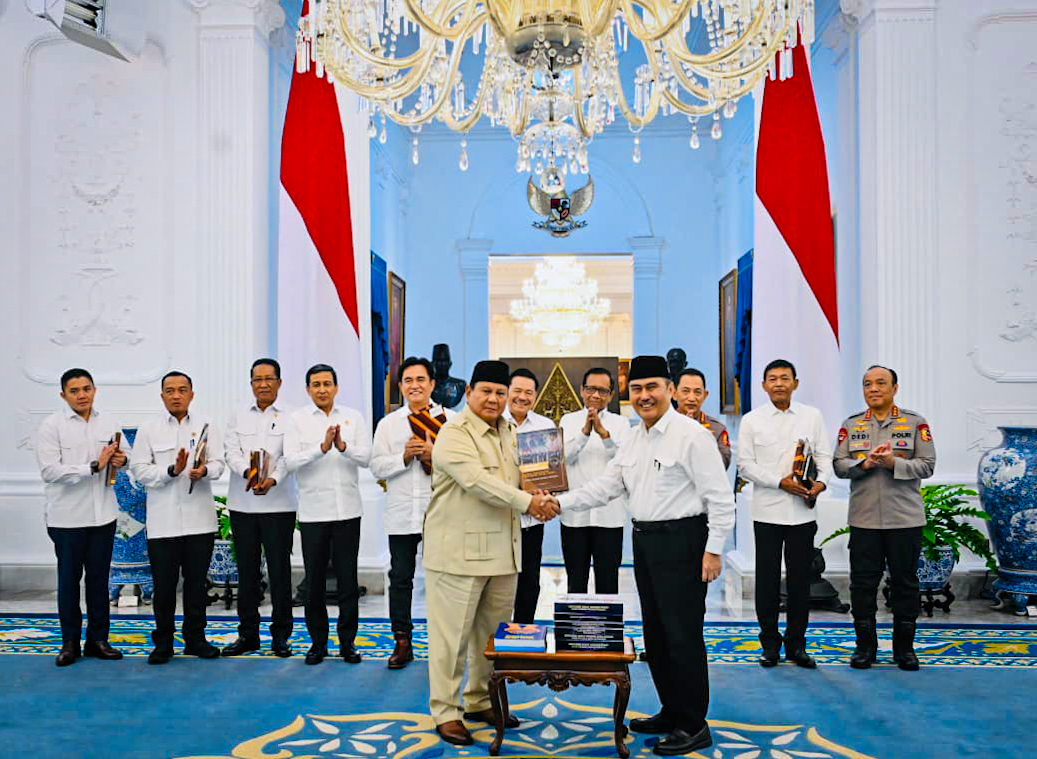
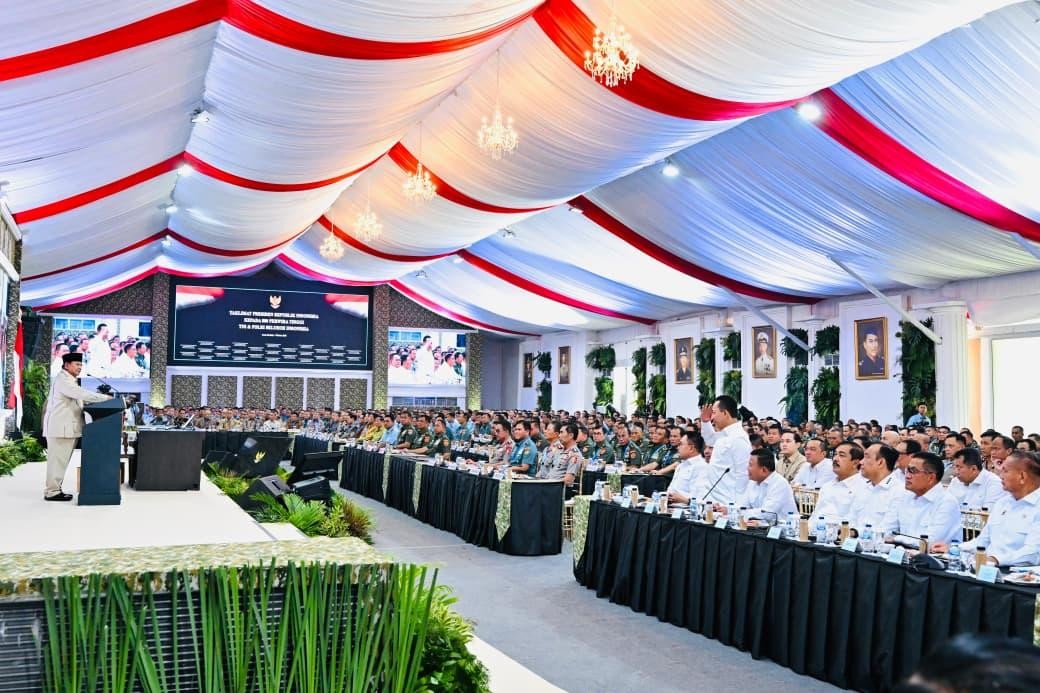
President Prabowo, on Tuesday (05/05), receives the Commission for the Acceleration of Police Reform (KPRP) at the Merdeka Palace, Jakarta. (Photo by: BPMI of Presidential Secretariat)
President Prabowo Subianto, on Tuesday (05/05), met with the Commission for the Acceleration of Police Reform (KPRP) at the Merdeka Palace, Jakarta, to discuss comprehensive reports on the national police reform agenda, including short and medium-term policy directions.
Chairperson of KPRP Jimly Asshiddiqie stated that the commission has reported on all its work results since its establishment, including the process of gathering aspirations from various parties. He further added that the commission has held numerous meetings with stakeholders, including state institutions, community organizations, and internal police forces. It has also visited several regions to gather public aspirations regarding the reform.
The work results were then formulated into 10 reports containing comprehensive policy recommendations for reform. The Chairperson stated that these recommendations range from proposed revisions to the National Police Law to the formulation of derivative regulations to support the implementation of the reforms.
“Earlier, we’ve submitted 10 reports, covering overall policy reform and alternative policies to be implemented by the Government and the National Police internally,” the Chairperson said in a press statement.
In addition, the commission also proposed an internal reform agenda, including changes in several national police regulations. These reforms are expected to be implemented by 2029 as part of the medium-term agenda.
During the meeting, President Prabowo accepted various points raised and gave directives on several strategic issues. One of these concerns the proposed establishment of a Ministry of Security, which it was ultimately decided not to proceed with.
“We’ve agreed not to propose the establishment of a new ministry. However, the President also asked us to explain, and we stated that the harm outweighs the benefits. Therefore, we decide not to proceed with the proposal,” the Chair explained.
Regarding the mechanism for appointing the National Police Chief, the President has decided to maintain the current mechanism. The National Police Chief will continue to be appointed by the President with the approval of the House of Representatives (DPR).
“After discussing the pluses and minuses, the President ordered that the mechanism remains as it is now. Therefore, the National Police Chief will continue to be appointed by the President with the approval of the House of Representatives, as is the current practice,” he said.
In addition, the President also discussed strengthening the external oversight function of the National Police through the National Police Commission (Kompolnas). In this regard, the President approved strengthening the role of Kompolnas to ensure greater independence and binding authority.
“The President strongly approves of strengthening the Kompolnas. The commission will be enhanced so that its decisions and recommendations become binding, and its membership will no longer be granted ex officio, as it is now, but will be independent,” the Chair said.
The Government will also strictly regulate the positions that national police members may hold outside the police force. These positions will be defined restrictively within the legislation.
This meeting marked the final stage of the KPRP’s duties after completing its mandate, which began with its inauguration by President Prabowo on November 7, 2025. The recommendations will serve as the foundation for formulating policies and regulations to enhance the National Police institution in the future.
The Government has also reaffirmed its commitment ensuring that police reform is not merely a matter of discourse, but rather a measurable, long-term strategic agenda oriented toward the interests of the people and the rule of law. (BPMI of Presidential Secretariat) (FI/TM)