
President Prabowo Receives DEN Report on Economic Impacts of MBG Program on MSMEs


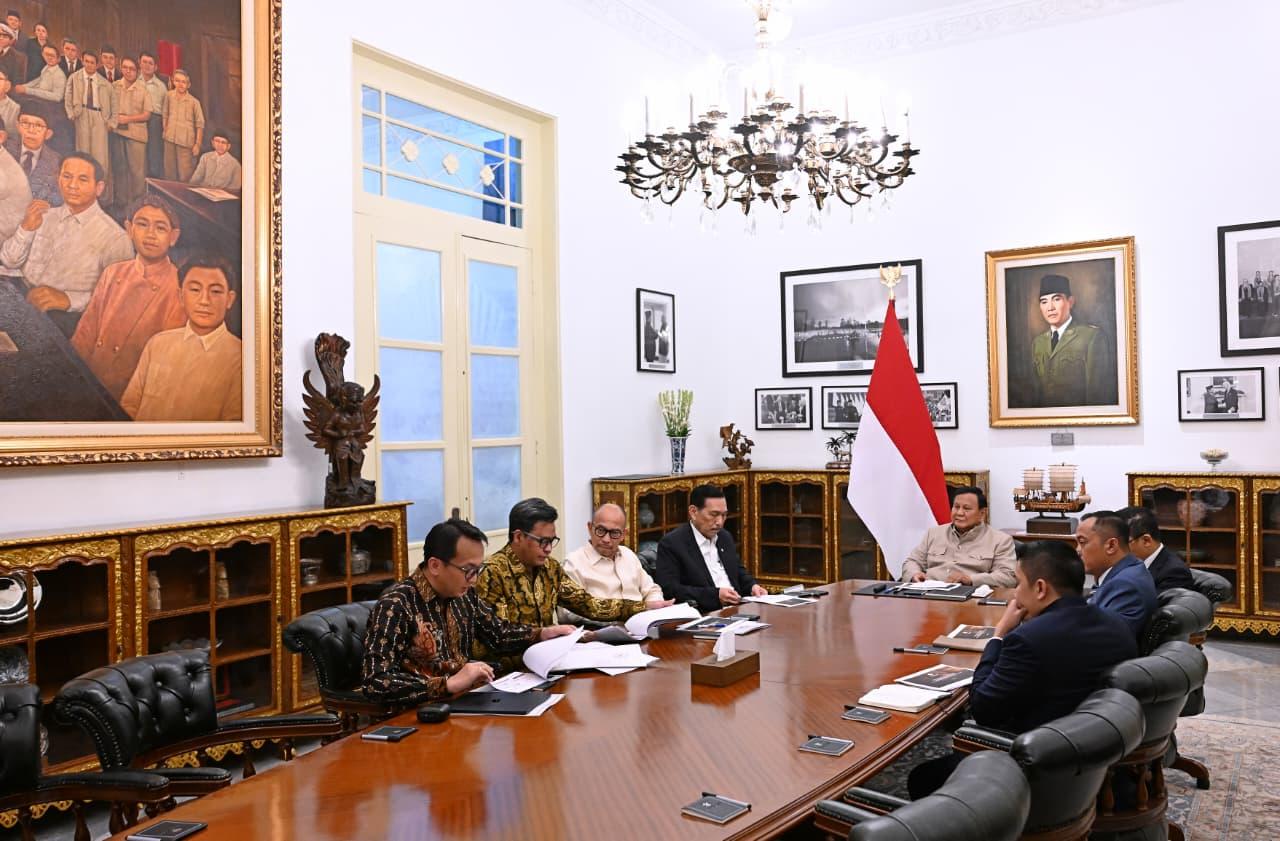
President Prabowo Subianto received Chairperson of the National Economic Council (DEN) Luhut Binsar Pandjaitan and his delegation at the Merdeka Palace, Jakarta, on Tuesday (06/09). During the meeting, DEN reported the results of independent survey regarding the implementation of the Free Nutritious Meal (MBG) program, which demonstrated positive impacts not only on fulfilling the nutritional needs of Indonesian children but also on the growth of micro, small, and medium enterprises (MSMEs) and the creation of new local economic ecosystems.
DEN Chairperson Luhut Binsar Pandjaitan explained that the survey was conducted professionally and independently to ensure the credibility of the findings presented to the President.
“The survey on the implementation of MBG program across 800 locations was carried out with utmost professionalism. At DEN, we place great importance on maintaining our credibility, and these are the results we have reported to the President,” Luhut stated in his remarks following the meeting.
DEN Secretary Septian Hario Seto explained that the survey was conducted independently and funded by DEN, utilizing random sampling of 800 Nutrition Fulfillment Service Units (SPPGs) located throughout Indonesia. Based on the survey results, DEN found that the MBG program has created new economic opportunities for MSMEs surrounding the SPPG locations.
“The first positive result we observed is that 86.9 percent of existing SPPGs work with at least one small-scale supplier. These are MSMEs located near the said SPPGs. On average, each SPPG partners with three MSMEs,” Septian revealed.
According to him, these findings indicated that the MBG program not only contributed to improving children’s nutritional intake but also fostered the development of new supply chains involving local businesses. DEN also noted that approximately 65 percent of MSMEs participating in MBG supply chain are located from the same regency as the SPPG they served.
“What is even more interesting is that around 65 percent of these MSMEs operate within the same regency as the SPPGs. So, it is important to note that these are not large suppliers stepping in, but local MSMEs that have emerged and grown within the communities where the SPPGs are located,” he explained.
In addition to supporting MSMEs growth, the survey also demonstrated positive impacts on local employment. Nearly all workers involved in SPPG operations came from the surrounding communities.
“Our third finding concerns employment. Nearly 99 percent of the workforce involved came from local residents,” he stated.
Nevertheless, DEN believed that there is still room for improvement, particularly regarding capital support for MSMEs to enhance their business capacity and diversify products supplied to SPPGs. DEN also noted that the economic impacts generated by the MBG Program have contributed to national economic growth.
“We observed that this is one of the factors that helped driving our [economic] growth to 5.61 percent,” Septian said.
The survey results were presented to the President as part of the Government’s ongoing evaluation efforts to ensure that the MBG program provides benefits not only in terms of public health and nutritional fulfillment but also as a catalyst for local economic development across Indonesia.
“This is what we reported to the President regarding the independently conducted MBG survey by the National Economic Council,” he concluded. (BPMI of Presidential Secretariat) (YA/MMB)