
Gov’t to Upgrade 10,000 Puskemas and Renovate Schools Nationwide


President Prabowo Subianto has outlined several strategic policy initiatives for the next phase of Indonesia’s transformation, with particular emphasis on the health and education sectors.
The Government plans to upgrade 10,000 puskemas (community health centers), strengthen more than 440 regional public hospitals, and complete the renovation of all schools in need of repair.
The President conveyed these policy priorities in his state address presenting the Government’s statement on the Bill on the State Budget (APBN) for the Fiscal Year 2027 and its Financial Note and supporting documents.
The address was delivered at the plenary meeting marking the opening of the First Session of the 2026–2027 Parliamentary Year of the Indonesian House of Representatives (DPR RI), held at the Nusantara Building of the MPR/DPR/DPD RI complex in Jakarta on Friday (08/14).
“Today, I wish to take this opportunity to address this honorable Assembly and outline several major policies that will shape the next chapter of Indonesia’s transformation,” said the President.
In the health sector, the President emphasized that puskesmas must serve as the as the frontline of the nation’s public health system.
Beginning in 2027, the Government will renovate 10,000 puskesmas across Indonesia, with approximately Rp4 billion allocated for improvements at each facility. Greater attention will be directed to disadvantaged, frontier, and outermost regions.
The Government will also renovate or construct 514 labkesmas (public health laboratories) across all regencies and cities in Indonesia.
“The people should not have to travel long distances to receive basic health services. The state must be present as close as possible to where the people live,” affirmed the President.
To expand access to health care in remote and hard-to-reach areas, the President also called for innovative measures, including the deployment of air ambulances using helicopters and small aircraft.
The Government is also considering the deployment of “flying medical teams”, which would allow medical personnel to travel directly to communities where residents face critical illnesses or have been affected by disasters.
“If necessary, we will deploy flying medical doctor teams, so that can travel directly to people who are seriously ill or those affected by disasters,” the President stated.
In addition to strengthening primary healthcare services, the Government will develop and revitalize more than 440 regional general hospitals to ensure that every regency and city has access to modern medical care. The program will prioritize treatment for leading causes of death, including cancer, heart disease, stroke, and kidney disease, as well as providing maternal and child healthcare.
As an initial step, the Government has built 66 hospitals in underdeveloped, frontier, and outermost regions, with 20 already operational.
“No mother should ever lose her life because the nearest hospital is too far away. No father should have to sell everything he owns to obtain proper treatment in a major city,” stated the President.
The expansion of healthcare infrastructure is also being matched by efforts to tackle Indonesia’s shortage of medical personnel.
The President also stated that Indonesia still needs an additional 84,781 general practitioners, 127,580 dentists, and 55,712 specialist doctors across 481 regencies and cities.
The Government has opened nine new medical faculties, along with 170 specialist and subspecialist programs, and will continue pursuing innovative measures to accelerate efforts to meet the country’s demand for doctors.
“We must not think conventionally, we must have the courage to think innovatively,” the President said.
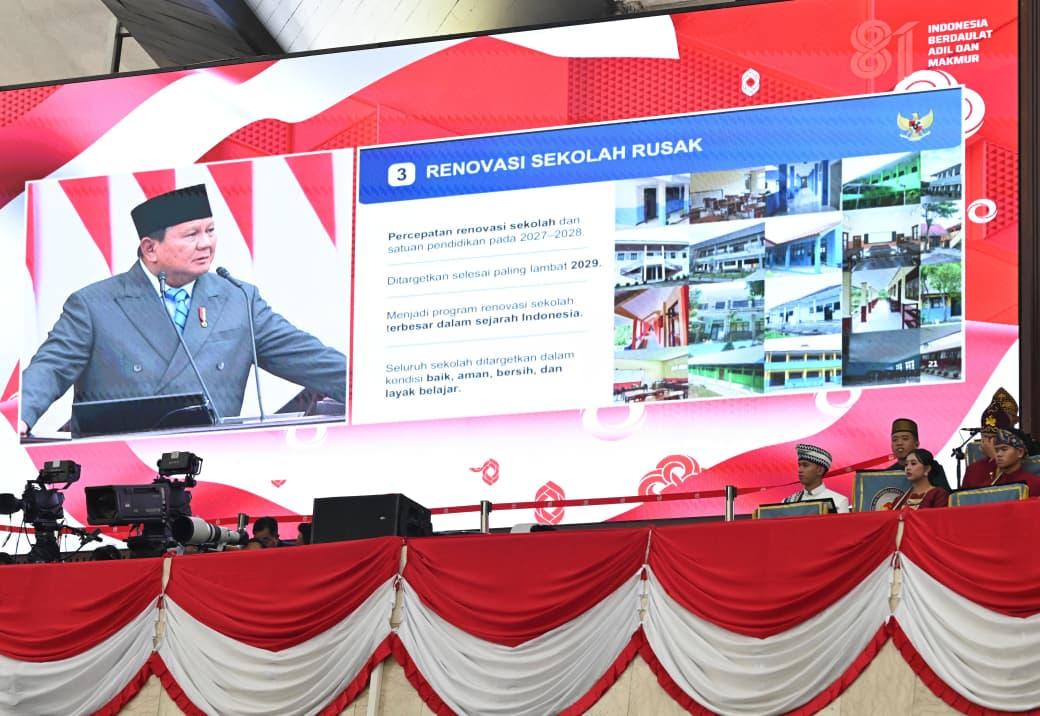
In the education sector, the President has set a target to complete renovations of all schools and educational facilities requiring repair by 2029.
The Government will accelerate the program in 2027 and 2028 to ensure that no Indonesian child has to study in classrooms with leaking roofs, cracked walls, damaged toilets, or unsafe building conditions.
“This is the largest school-renovation program in Indonesia’s history, Ladies and Gentlemen. We must have the courage to set high targets. There must be no more stories of schools collapsing, and no more classrooms left in disrepair for years,” said the President.
Alongside school-infrastructure improvements, the Government will expand interactive flat panels (IFPs) in classrooms and develop distance-learning programs.
By the end of 2026, it aims for every school to have four IFP-equipped classrooms, allowing students nationwide, including those in remote areas, to access lessons from leading teachers through centrally based teaching studios.
The President also reaffirmed the Government’s commitment to ensuring that education at all public schools is accessible free of charge. According to him, education is the right of every Indonesian child and serves as a fundamental foundation for accelerating the nation’s development.
“Every Indonesian child is entitled to education. Those who can afford, you may go to top private schools. However, the Government will strive to provide free education for our children,” concluded the President. (BPMI of Presidential Secretariat) (TC/EP)