
New Nutritious Agency Head Affirms Commitment to Maximize Free Meals Program Benefits


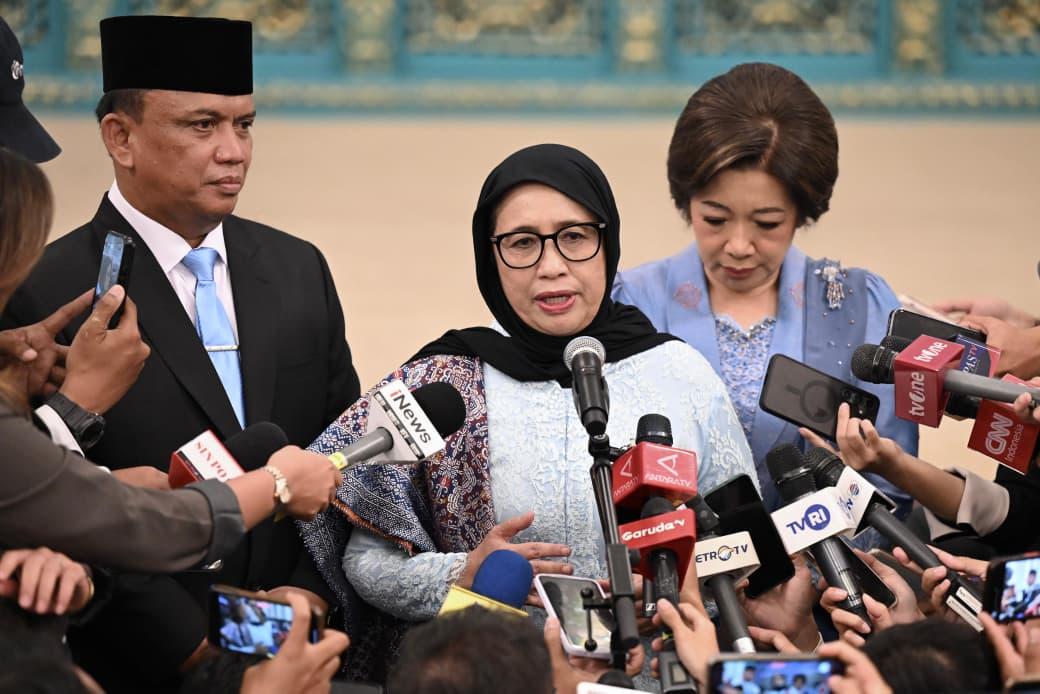
Head of the National Nutrition Agency Nanik S. Deyang delivers a press statement at the State Palace, Jakarta, on Tuesday (06/08).
Following the inauguration of the new Head of the National Nutrition Agency (BGN) on Tuesday (06/08), the newly-appointed (BGN) Head Nanik S. Deyang affirmed her commitment, to work together with Deputy Head Agustina Arumsari and Trenggono, in maximizing the benefits of the Free Nutritious Meals (MBG) program through a series of efficiency measures.
“Our concern relates to budget efficiency so we must ensure that the program does not burden the current state budget, while still maintaining the nutritional targets we aim to achieve,” Nanik said.
Furthermore, she stated that a moratorium is imposed as the initial step in implementing the efficiency measures by assessing the ideal number of kitchens needed to serve the beneficiaries. She explained that this step is part of a restructuring effort aimed at mapping the needs of each region.
“We are assessing and evaluating whether these existing kitchens are sufficient to serve the beneficiaries, or whether there are actually too many,” she said.
Nanik also said the agency will refocus the program’s beneficiary targets to ensure that the MBG program only targets those most in need of nutritional intervention.
“We will prioritize children or beneficiaries who truly need nutritional intervention. We will refocus the program to determine whether the current target of 63 million beneficiaries truly reflects the number of people in need, or whether the number could actually be reduced and later be expanded to include those who have not yet received assistance,” she explained.
On that occasion, Nanik also stated that her agency will focus on strengthening the quality of the MBG program to ensure that the kitchens currently operating are functioning according to existing technical guidelines.
“We have also informed the President that in 2026 our priority will be quality, not quantity. Therefore, we will evaluate whether the existing kitchens comply with the technical guidelines or not,” she added.
Regarding the program in underdeveloped, frontier, and remote regions (3T areas), Nanik explained that the agency will seek to build collaborations with various parties, including companies through Corporate Social Responsibility (CSR) programs.
“For regions that have not yet been covered by investors, we will seek partnerships, or perhaps funding through the CSR programs of state-owned enterprises, or grants from abroad, or even from large companies investing in those areas,” she said.
Through these measures, the National Nutrition Agency reaffirmed its commitment to delivering a more effective, sustainable, and impactful MBG program aimed at fostering a healthy, strong, and competitive generation of Indonesians. (BPMI of the Presidential Secretariat) (RAS/LW)