
President Prabowo Announces Indonesia International Financial Center, Pushes for Long-term Strategic Project Financing


President Prabowo Subianto reaffirmed the Government’s commitment to establishing a national economic foundation that is strong and long-term oriented. This commitment is part of Indonesia’s next phase of transformation through the establishment of the Indonesia International Financial Center (PFII) and the Danantara Development Management Fund (DDMF), as well as the construction of the Giant Sea Wall on the North Coast of Java.
The President delivered these three strategic agendas during the Presentation of the Government’s Statement on the Bill on the State Budget for the 2027 Fiscal Year and Its Financial Note before the Plenary Session of the House of Representatives of the Republic of Indonesia for the 2026-2027 Parliamentary Year, held at the Nusantara building, Parliamentary complex, Jakarta, Friday (08/14).
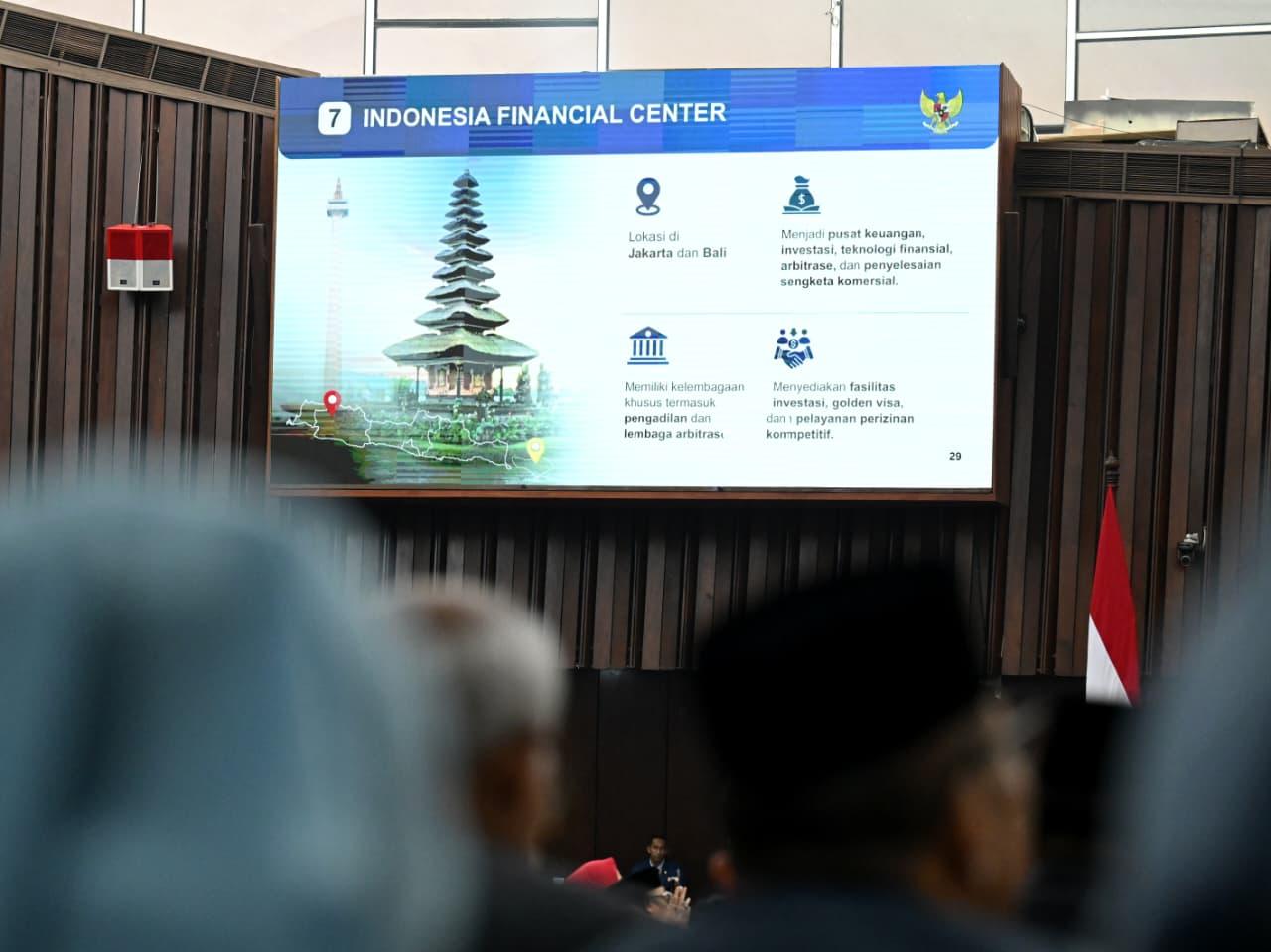
He stated that the Government has decided to locate the PFII in Jakarta and also explores opportunities to expand the PFII in Bali and other regions in Indonesia that have the potential to attract large foreign investment.
“The PFII will serve as the new face of Indonesia’s financial hubs, with Jakarta and potentially Bali serving as world-class hubs for finance, investment, fintech, arbitration, and commercial dispute resolution. The institutional structure of the PFII consists of the Advisory Council, the PFII Council, the PFII Management Agency, the PFII Financial Services Supervisory Agency, the PFII Court under the Supreme Court, and the PFII Arbitration Center,” the President stated.
President Prabowo also underscored that the PFII would ensure certainty for transfer and repatriation of capital and profits, tax facilities for eligible activities, golden visas, and competitive licensing services. He also emphasized that these measures must come with good governance and compliance principles. Anti-money laundering regulations, beneficial ownership transparency, tax obligations, and international information exchange will continue to be enforced.
“We establish the PFII to provide certainty for global capital investment in Indonesia, to provide good opportunities for top-tier talents to work in Indonesia, and to settle transactions involving the country’s wealth in Indonesia,” the President emphasized.
On the occasion, the President also introduced the Danantara Development Management Fund (DDMF) as an instrument to support the nation’s capacity building in the long-term. He explained that Danantara manages Indonesia’s sovereign funds, serving as an instrument for building national capacity for decades to come. Meanwhile, the DDMF is responsible for preparing, developing, and financing long-term strategic projects that are vital to the nation but not viable for short-term commercial investment, while also avoiding putting a burden on the State Budget.
“The DDMF is an instrument which prepares, develops, and finances long-term strategic projects which are vital to the nation but not presently viable for short-term commercial investment, and which we also avoid financing through the State Budget. Through the DDMF, Indonesia’s sovereign wealth fund will be invested in a disciplined and professional manner, as evidenced in, for example, the implementation of the national car project. We plan to begin mass production of our national car by the end of 2028,” the President explained.
In addition, the President also highlighted the importance of the construction of the Giant Sea Wall spanning across the north coast of Java to protect communities and industrial areas from the threat of rising sea levels.
“The Giant Sea Wall on the north coast of Java must be built without delay and will serve as a shield of protection for millions of people living along the coast and tens of thousands of hectares of land that have started to sink due to rising sea levels. This wall must serve as clean water infrastructure, a new corridor for growth, and an engineering project that elevates our generation’s expertise,” the President added.
Furthermore, the President explained that the National Research and Innovation Agency (BRIN) has made various technological breakthroughs generally applicable in the construction of the Giant Sea Wall. It is estimated to take 15 to 20 years to finish the construction.
“We plan to divide the construction into 15 segments from Banten to East Java, to Gresik. If constructed simultaneously, the wall could be completed in less than 20 years. We must have the courage to start. This concerns the lives of millions of our people living on the north coast of Java, and we must take into account industries located along the north coast from West Java to East Java. So, the future of our industry is at stake,” he stated. (BPMI of Presidential Secretariat) (RD/TM)